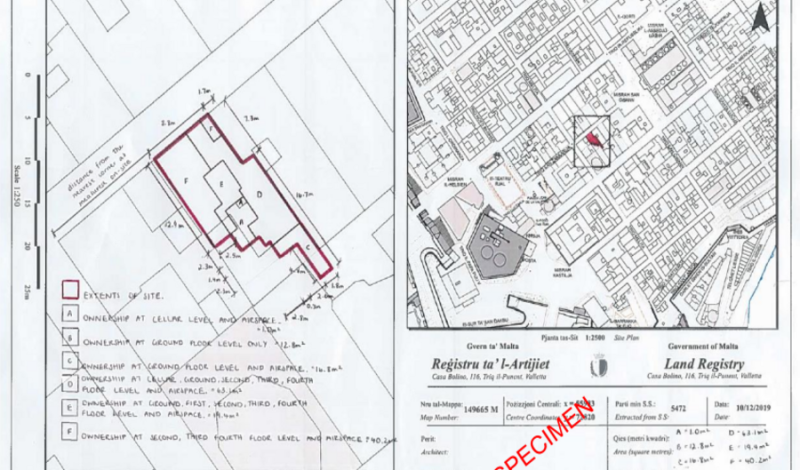
The importance of a plan attached to a contract of sale is not limited to properties situated within a Land Registration Area. That is only one context in which the plan assumes formal registration importance. The wider legal point is more fundamental: a plan annexed to a promise of sale or final deed helps identify the object of the sale. It gives physical expression to the written words of the contract and may fill the gaps which the textual description leaves open.
A deed may describe a property by address, boundaries, name, area, title history or general description. Yet words alone may not always capture the full physical and legal reality of what is being transferred. Maltese property is often complex. Rights may depend on small physical distinctions: whether a yard is exclusive or common; whether a staircase belongs to one unit or serves several; whether a passage is private, common, or subject to a servitude of access; whether a roof, shaft, terrace, basement, airspace, backyard, alley or drive-in is included in the sale or excluded from it.
In such cases, the plan is not a mere convenience. It becomes an interpretative tool. Maltese case law has recognised that, where a plan forms part of the contractual documentation, it may assist in determining what the parties intended to transfer, especially where the written description is incomplete, ambiguous or insufficiently precise. In simple terms, the plan helps the contract speak. It does not replace the deed, but it helps give the deed its concrete spatial meaning.
This is why the plan should ordinarily be furnished by the vendor. The vendor is the person selling and warranting the property. He is the party effectively declaring: this is mine; this is what I am transferring; these are its limits; these are the rights attached to it; these are the burdens affecting it; this part is exclusive; this part is common; this access exists as of right; this area is not included. The purchaser must still verify all this through proper due diligence, but the first act of identification should logically come from the person who is transferring title.
The refrigerator example captures the point well. When a supplier sells a refrigerator, the manual, specifications and guarantee come from the supplier, not from the buyer. They are not supplied as a favour. They form part of responsible delivery. The buyer may inspect the item, compare the model and ask questions, but he is not expected to prepare the manual himself. In the same way, a vendor of immovable property should not merely sell an address and leave the purchaser to reconstruct the object of the sale. The plan forms part of the responsible delivery of title.
The same logic applies elsewhere. When a car is sold, the seller does not leave the buyer to identify the chassis number and registration details. When machinery is sold, technical specifications identify what is being supplied. When a parcel is delivered, the label tells one where it is going. In immovable property, the need for precision is even greater, because land cannot easily be returned like a defective object, and uncertainty may later affect possession, access, development, financing and resale.
The ramifications of an unclear plan can be serious. It may lead to disputes about whether a yard, roof, basement, shaft, staircase, garage, terrace or strip of land was included in the sale. It may create uncertainty as to whether access exists legally or merely by tolerance. It may leave unclear whether an area is exclusive or common, or whether the property is burdened by servitudes or third-party rights.
For that reason, the promise of sale should, where appropriate, require the vendor to provide a proper plan before the final deed, identifying the property’s extent, levels, access, common parts, exclusive areas, rights of way, servitudes and other relevant real rights or burdens. This does not remove the purchaser’s duty to verify, nor does it replace the role of the notary or perit. It simply places the primary burden where it naturally belongs: on the person who is selling and guaranteeing what is being sold.
A vendor does not merely sell an address. He sells a defined immovable thing. The plan helps show what that thing is.