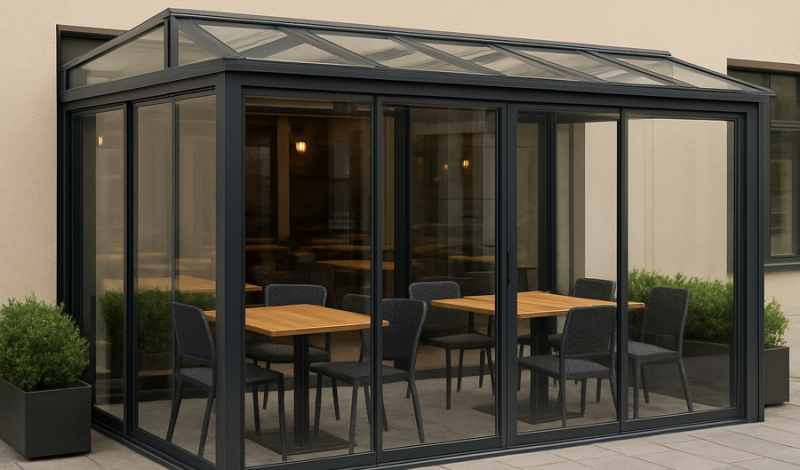
It is submitted, first and foremost, that transparency does not negate mass. In planning and visual terms, enclosing an open structure in glass almost invariably converts openness into built form: continuous planes of glazing read as a volume, introduce new linear edges, generate reflections and invite further visual clutter through safety markings and graphics. This is particularly significant in the immediate setting of fortifications and other scheduled fabric, where the open foreground is often an integral part of how the monument is experienced. Even where the material is colourless, the effect is to reduce open-space character and to set up a contemporary visual element that competes with the stonework for attention. The claim that “one can see through it” does not alter the fact that, from near and far, the viewer is presented with a new man-made mass where previously space was void.
On a proper reading of Maltese policy, such interventions face a high bar. Monument-focused local plan policies, such as GH04 in the Grand Harbour context, expressly acknowledge the “important role” of national monuments and then stipulate that no development is to be allowed in their vicinity if it would adversely affect them, or where it would reduce or compete with their importance. Open-space designations on local plan maps, often described in terms such as “to retain open space character”, reinforce this by identifying areas whose value lies precisely in remaining visually free around the fortifications. Superimposed on this are the SPED Urban Objectives. Urban Objective 3 requires the planning system “to identify, protect and enhance the character and amenity of distinct urban areas”; Urban Objective 2 seeks “to improve the townscape and environment in historic cores and their setting with a presumption against demolition of property worthy of conservation”; Urban Objective 4 insists that new development “provide a sense of place, respond to the local character, improve amenity and the pleasantness of place and ensure safety”. Read together, these objectives and policies create a strong presumption that, in fortification settings, new enclosure and volume in front of or immediately adjoining the historic fabric are the exception, not the rule.
Article 72(2) of the Development Planning Act and Policy P1 of DC15 explain how the existence of other development and “commitments” is to be factored into this analysis. Policy P1 provides that, in analysing an existing context, the extent of commitments includes: (1) existing legal development physically present on site; (2) valid unbuilt permissions; and (3) future commitments provided for in local plans. Article 72(2) then sets out the hierarchy of considerations: the Planning Board must have regard to plans and policies, to regulations made under the Act, and only then to “any other matter of substance”, including legal commitments in the vicinity and environmental and aesthetic considerations, as well as public representations and the recommendations of boards and consultants. The Court of Appeal has underlined that the legislator’s emphasis lies on adherence to laws, plans and policies, and that commitments and other factors may be weighed only so far as they do not nullify these. The principle that follows is simple but important: past permits and nearby structures are relevant in understanding context, but they cannot override clear monument and open-space policies, nor can they turn what is contrary to SPED objectives into something acceptable.
On the same logic, arguments based on legitimate expectation must be viewed cautiously in this field. A prior permission for an open and relatively light intervention does not, without more, create an expectation that more intense enclosure will be authorised on the strength of that permission, particularly where heritage sensitivities were already acknowledged. In heritage settings, earlier compromises often confirm that the balance of policy is already at, or near, its limit; they do not compel a further step towards enclosure. To treat any existing intervention as a blank cheque for additional massing would be to invert the structure of Article 72(2) and Policy P1, which place plans and policies at the apex and treat commitments as secondary.
It is further submitted that conditions under Article 72 cannot be used to “seasonalise” what remains contrary to policy in principle. The statute allows the imposition of conditions, but these presuppose an underlying compatibility with the planning framework. They are intended to regulate the manner in which acceptable development is carried out, not to validate, for part of the year, development that is fundamentally at odds with monument-protection policies, open-space designations and SPED Urban Objectives. If an enclosure in glass is judged to undermine the primacy of fortifications or to erode designated open-space character, that conclusion does not change simply because the glazing would be present only in winter; the conflict with the year-round objectives of the SPED and the local plan remains.
Finally, expert heritage advice is central in gauging where the line lies between tolerable adaptation and unacceptable encroachment. Article 72(2)(f) expressly requires that recommendations from boards, committees and consultants be taken into account. In fortification contexts, the specialised cultural heritage authority is uniquely placed to evaluate visual impact, authenticity, cumulative risk and precedent. Where that authority signals that additional enclosure in glass, or similar alien material, would harm key views, weaken the legibility of defensive lines or open the door to further accretions, such advice sits squarely within the objectives of Urban Objectives 2, 3 and 4 and monument policies like GH04. In the absence of exceptional countervailing considerations, it should therefore carry substantial weight. On this reading, the governing principles in Maltese law are clear: transparency is still mass; in fortification settings, glass enclosure almost always diminishes open-space character and competes with stone monuments; strong monument and open-space policies, reinforced by SPED, set a high threshold for accepting such interventions; previous permissions and neighbouring structures cannot dilute that framework; and conditions cannot be used to do, even temporarily, what the policy system itself regards as impermissible.