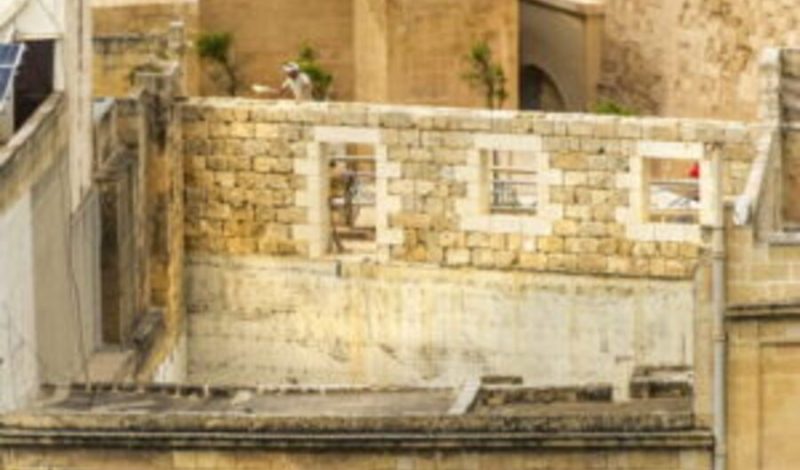
The Maltese Civil Code is clear: when a property has a staircase leading to an accessible roof, the owner is legally required to construct a 1.8-metre-high dividing wall to prevent overlooking and safeguard privacy. Indeed Article 427(1) of Chapter 16 states as follows:
‘The person in whose building there are stairs leading to the roof, is bound to raise at his own expense the party-wall to the extent of one metre and eighty centimetres above the level of the roof.’
At first glance, the wording of this provision leaves little room for flexibility. The legislative intent behind it is to ensure privacy and prevent introspezzjoni (overlooking) into a neighbor’s property, as emphasized in Adelina Cini v. Katerina Zammit et (22 April 2009):
“Jista’ jingħad illi llum il-ġurnata l-iskop ewlieni ta’ din is-servitu’ partikolari u l-vantaġġ li jikkreja għall-fond dominanti, hu dak tal-privatezza u ċioe’ sabiex tiġi eliminata l-inkonvenjenza li wieħed jittawwal x’ħin ifettillu għal fuq ħwejjeġ il-ġar tiegħu minn fuq dan il-bejt.”
(Translation: “It can be said that today, the primary objective of this servitude and the advantage it provides to the dominant property is that of privacy, that is, to eliminate the inconvenience of someone being able to overlook their neighbor’s property at will from this roof.”)
However, recent case law reveals that courts are not always enforcing the said 1.8-metre rule in a strict manner and are, instead, favouring practical adjustments, particularly in situations where privacy can still be preserved by alternative means. A notable example of judicial flexibility is found in the court of appeal 2023 Sprint Holdings Limited v. Joseph u Carmelina Zammit case. Here, a penthouse owner objected to the strict application of Article 427(1) because it would have obstructed their sea view. Rather than imposing the full 1.8-metre wall, the court allowed a compromise, ordering that:
“Iċ-ċint (ossia ħajt baxx tal-kantun b’railing fuqu) għandu jiġi ritirat ‘l ġewwa 0.45m sabiex jiġi ottenut l-istess effett tal-Art. 427(1), ċjoè li l-proprjetà tas-soċjetà attriċi ma ssofrix introspezzjoni u fl-istess ħin il-konvenuti ma jitilfux il-veduta.”
(Translation: “The fence (a low wall with a railing) had to be moved inward by 0.45m to achieve the same effect as Article 427(1), ensuring that the plaintiff’s property did not suffer overlooking, while at the same time allowing the defendants to retain their sea view.”)
This judgment raises crucial legal questions: has the judiciary created a de facto exception to Article 427(1)? Traditionally, servitudes have been applied strictly, but this evolution in case law suggests that courts now assess the real impact on privacy before enforcing rigid servitude rules, allowing for proportionate solutions where a compromise solution still achieves the same legal objective.
On an equally relevant note, Article 427(1) refers to roofs. But what about terraces and balconies that extend to the dividing line? Terraces and balconies often create the same privacy concerns as accessible roofs. This is yet another grey area that requires legislative clarity. If the law is meant to prevent introspezzjoni, then shouldn’t terraces and balconies be explicitly regulated just as accessible roofs are? Some case law suggests so and specifically refers to a “setaħ” (open terrace or courtyard) as being considered equivalent to a roof for the purposes of Article 427 of the Civil Code. However, a more recent court judgment, delivered following a decision by the Environment and Planning Review Tribunal, has unequivocally established that the side curtilage of a villa overlooking another villa at a lower level cannot be equated to a roof for the purposes of Article 427 of the Civil Code.
While this case-by-case approach has allowed for pragmatic outcomes, it also raises questions about legal certainty. Perhaps it is time for the legislator to acknowledge what is already happening in judicial practice. If privacy concerns can be addressed without rigidly applying a 1.8-metre rule, then the law should provide clearer guidance on when alternative measures are acceptable. At the same time, the question of balconies and terraces remains open. The conversation on servitudes is far from over. Judicial practice has already introduced practical flexibility—now, perhaps, the law should follow suit.