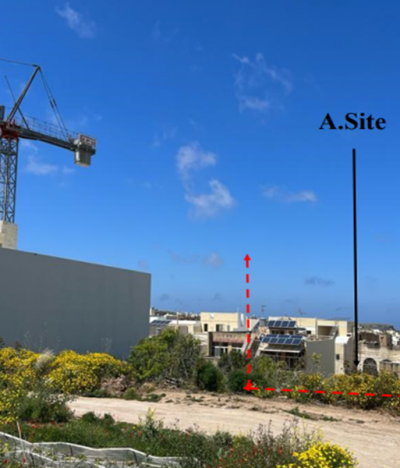
In Urban Conservation Areas, planning law is often tested not by large-scale redevelopment but by modest interventions that affect the roofscape. A party wall raised at roof level may appear, at first sight, to be a private adjustment between neighbours. Yet once that wall becomes visible from the public realm, it ceases to be a purely private matter. It becomes part of the streetscape, the skyline, and the architectural language of the area. At that point, it is properly regulated by planning law.
This distinction explains why planning assessment cannot be reduced to what civil law allows or requires. Civil law regulates relationships between neighbouring owners, including privacy and boundary obligations. Planning law, by contrast, regulates the physical expression of development in space. Where the real issue is visual impact, urban form, and compatibility with a protected context, the question is not who may build a wall, but whether that wall belongs in the place where it is proposed.
This is why reliance on Article 409 of the Civil Code cannot determine the planning outcome. The Civil Code may permit, and in some cases oblige, the raising of a party wall for privacy or protection. But that obligation does not answer the planning question. Planning authorities and tribunals are not being asked to adjudicate civil rights, servitudes, or title. They are being asked to assess the effect of a built intervention on an Urban Conservation Area. That distinction has been recognised judicially, including in cases where it was confirmed that civil disputes about rights may proceed separately, while planning permission remains subject to planning control and policy compliance.
The principle that a permit may issue “subject to third-party rights” does not dilute this duty. That formula applies where civil rights are contested or unclear. It does not convert a planning authority into a passive observer when the harm alleged is architectural and urban in nature. Where the intervention itself alters skyline, proportion, or visual coherence, the issue is intrinsically one of planning competence.
At the centre of this assessment lies the context-driven approach, which is the backbone of DC15. Context is not treated as a stylistic preference but as the governing principle of design assessment. Development must be read against its immediate surroundings: prevailing heights, roof relationships, materials, and the organic irregularities typical of older settlements. This approach is especially strict in Urban Conservation Areas, where protection is based precisely on continuity and coherence rather than uniformity.
The iSPED reinforces this logic in concrete terms. Urban Objectives 2.3 and 2.4 require height control in conservation areas to be driven by context and prohibit development that adversely affects the traditional skyline. These objectives are not limited to new storeys or large extensions. A vertical extension to a party wall can have the same skyline effect, particularly where differences in roof levels amplify its visual presence. A wall raised above the highest roof line can easily become a permanent blank element, altering how the roofscape reads as a whole.
This is why planning law treats roof-level boundary walls with caution. Their impact is rarely neutral. Once they exceed prevailing parapet heights, they risk introducing dominant vertical elements that disrupt the established balance of the street. In conservation areas, that balance is not incidental; it is the very quality being protected.
Privacy is often advanced as justification for such walls, and it must be taken seriously. Dense village environments inevitably involve overlooking, especially where buildings have evolved organically rather than through uniform layouts. Planning policy recognises this reality. However, it does not accept that privacy concerns can always be resolved through higher and more solid barriers. DC15 Policy P41 addresses privacy through separation distances, changes in level, internal layout, aperture design, and screening. It does not promote tall roof-level walls as a default solution. The reason is obvious: if privacy were always resolved by vertical construction, conservation areas would quickly lose their character through cumulative enclosure.
This is not a denial of privacy interests, but a balancing exercise. Privacy must be achieved through means that respect the urban context. Planning law does not prohibit privacy solutions; it regulates their form.
Meanwhile, consultation responses do not alter this framework. Bodies such as the SCH and the DAC provide expert input, but their role is advisory. Under Article 72(2) of the Development Planning Act, the responsibility to assess compliance with plans and policies remains with the decision-maker. A lack of objection from a consultee does not amount to policy compliance, nor does it override the requirement to protect context and skyline. Planning judgment cannot be delegated.
The same discipline applies to comparative arguments. Examples from other streets, or even from elsewhere within the same locality, do not establish acceptability unless the context is materially the same. Differences in street hierarchy, conservation status, building height predominance, and roof level arrangements are decisive. Planning law does not operate on informal precedent. Structures authorised in different contexts, or even structures authorised in error, cannot justify departures from policy.
An important practical point emerges when civil law obligations are brought back into the picture. There are situations where the Civil Code may require an owner to raise or adapt a party wall. This creates a genuine risk for applicants. A planning permit authorises development only within planning limits. It does not guarantee that civil law obligations can later be satisfied through additional construction. Equally, a civil obligation cannot retrospectively justify a planning breach.
The responsibility therefore lies with the applicant to anticipate this interaction. If a design is approved that later proves incapable of accommodating a civil law obligation without breaching planning policy, the applicant may find themselves in a legal dead end: holding a valid permit, yet unable to comply with civil law without infringing planning control. That situation is not created by planning law. It arises from treating civil and planning regimes sequentially rather than holistically.
In sensitive contexts such as Urban Conservation Areas, that risk is heightened. Planning policy may deliberately restrict solutions that civil law might otherwise contemplate, precisely because of their visual and urban impact. Applicants must therefore design proposals that can satisfy both regimes from the outset, rather than assuming that civil law adjustments can always follow planning approval.
Taken together, these principles show how planning law approaches roof-level party walls in Urban Conservation Areas. The focus is not on ownership or entitlement, but on context, skyline, and visual coherence. Civil law obligations are real, but they do not displace planning discipline. The lesson is simple but important: in protected urban settings, lawful development depends not only on what an owner may do, but on how foresightfully civil and planning obligations are aligned before construction ever begins.