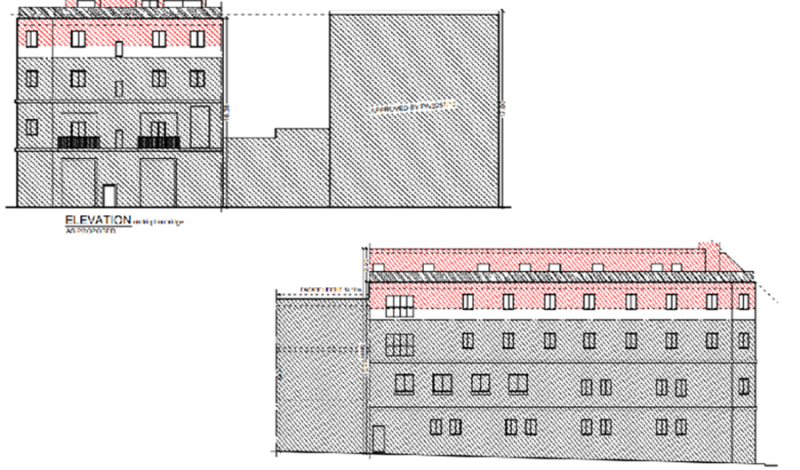
In its decision in Medsea Holdings Ltd, Attn: Anthony Vassallo vs L-Awtorità tal-Ippjanar (Appell 313/24JB, PA1427/23, decided 29 April 2025), the Environment and Planning Review Tribunal addressed a contested proposal to convert a former social club into a Class 4A office and extend the existing building to include a fourth recessed storey. The site, located in Triq ix-Xwieni, Marsa, falls within an area designated as 3 storeys/frontage under the Grand Harbour Local Plan. The Planning Authority had refused the application, citing conflict with Policy P35 and Annex 2 of the DC15 Guidelines on height limitations. The appellant, however, maintained that the proposed height was contextually justified and consistent with Policy P6 of DC15, which governs Transition Design Solutions.
Policy P6, particularly in its application to individual area typologies, allows for limited design flexibility in instances where a proposed development lies between existing buildings of different heights. It provides that: “Normally such transition will occur on the higher height limitation unless the higher height limitation is already committed, in which case the transition may occur on the lower height limitation.” Further scenarios outlined in the policy—such as those involving higher commitments flanking a site or an anomalous corner building—define the spatial conditions in which a height transition might be permissible, subject to safeguards including streetscape integrity, architectural quality, and compatibility with surrounding built form.
In the case at hand, the appellant argued that the proposed fourth storey would serve as a “step-up” between the existing 3-storey context and the nearby 4-storey zone. However, the Tribunal rejected this approach as a misapplication of Policy P6. It held that transition must flow from the higher to the lower designated area, not the reverse. As the Tribunal put it, “it-tranżizzjoni għandha ssir mis-sit bl-għoli massimu hekk kif stabbilit bil-pjan lokali għal dik aktar baxxa”—emphasising that it is the site with the greater height entitlement that bears the responsibility of creating a soft transition, rather than a lower site attempting to climb upward. The appellant’s interpretation was described as “propju fl-invers” of the policy’s intent.
Moreover, the Tribunal considered and dismissed various nearby developments cited by the appellant as indicative of contextual commitment, including the Carnival Village and structures developed under PA4158/04. These were either located in different policy zones (such as the 4-storey band across the street) or were approved under regulatory frameworks that predated the current policies. The Tribunal noted that such examples could not serve as legal precedents or generate a binding commitment that alters the applicable policy envelope. Referring to Michael Debrincat vs L-Awtorità tal-Ippjanar (Appell 55/2018), the Tribunal reiterated the principle that “ebda permess li jmur kontra dak li tgħid il-liġi ma jista’ jikkostitwixxi xi forma ta’ deroga.” In other words, historic irregularities or legacy permits cannot legalise new developments that depart from present regulatory standards.
The Tribunal also found that the local plan had already accounted for transition in zoning terms. Through Map 13 of the Grand Harbour Local Plan, a structured gradient was established across the broader urban fabric—from 6 storeys to 4 to 3—as one moves across the Albert Town area. The Tribunal thus reasoned that no further transitionary intervention was required within the same 3-storey zone, and that the existing planning framework already delivers an appropriate stepped height pattern.
In sum, the Medsea Holdings decision clarifies the obvious, namely a recurring point of interpretation in Policy P6 where transition design is intended to moderate abrupt changes in height between zones, proceeding from higher-designated areas toward lower ones. In this case, the attempt to use a lower-height site as a stepping stone toward a taller zone was rejected as contrary to the policy framework.
The decision also reiterates that isolated developments—particularly those approved under earlier regimes or situated in different zoning contexts—do not in themselves generate a commitment capable of overriding current height limitations. To this end, one could contemplate whether the concept of “commitment” should evolve beyond the treatment of individual permits to reflect a more holistic understanding of context—one that accounts for cumulative built form and streetscape patterns across a defined urban capture area.