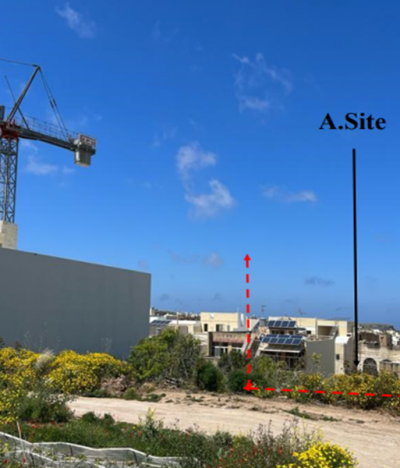
The Halland case is best read as a Court-led re-statement of what the Planning Authority and the Tribunal may lawfully do when a Local Plan contains two site-relevant provisions that cannot sit comfortably together. The site lay within the North Harbours Local Plan area and was tied to two competing map-driven signals: the zoning treatment on map SW2 pointing towards a low-density residential priority area in the detached/semi-detached category, and the map SW4 designation requiring the retention of the existing building heights, in circumstances where the pre-existing hotel massing exceeded what is ordinarily associated with that residential typology. The Authority and the Tribunal treated the site as exceptional and sought to reconcile those signals through a method that accepted the “retain heights” instruction while re-working typology and density controls through a selective application of parameters, including partial reliance on DC2015 provisions as “guidance”. The Court of Appeal recast the problem as one of legality rather than evaluative planning preference. It framed the legal question in express terms: “la darba huwa evidenti li d-dispożizzjonijiet rilevanti tal-istess pjan lokali u tal-pjanti li jifformaw parti integrali mal-istess pjan lokali, huma kontradittorji ma’ xulxin, setgħet l-Awtorità, u warajha t-Tribunal, jagħżlu huma liema parti mill-pjan lokali tkun applikata għall-każ u liema kellha titwarrab?”
English translation: “Once it is evident that the relevant provisions of the same local plan, and of the maps forming an integral part of that local plan, contradict one another, could the Authority, and after it the Tribunal, choose which part of the local plan would be applied to the case and which would be set aside?”
The Court then answered by laying down a strict rule for conflicts of this kind: “Fejn l-Awtorità ssirilha applikazzjoni ta’ żvilupp li għaliha jgħoddu policies konfliġġenti li huma ġerarkikament ekwivalenti, l-obbligu legali tagħha m’huwiex li tagħżel hi liema minn dawk il-policies huma applikabbli u tiskarta oħrajn ugwalment applikabbli, iżda li timxi kif trid il-liġi tal-ippjanar sabiex dak il-kunflitt jitneħħa.”
English translation: “Where the Authority is faced with a development application to which conflicting policies apply, which are hierarchically equivalent, its legal duty is not to choose which of those policies are applicable and to discard others that are equally applicable, but to proceed as required by planning law so that that conflict is removed.”
The Court’s reasoning also shuts the door on the idea that internal contradiction may be addressed by “building” a bespoke policy outcome through selective extraction of parts of planning instruments: “l-Awtorità m’għandhiex tiddetermina applikazzjoni billi toħloq hi stess policies, pjanijiet u regolamenti b’mod li m’huwiex kontemplat fil-liġi tal-ippjanar stess.”
English translation: “the Authority should not determine an application by creating itself policies, plans and regulations in a manner not contemplated by planning law itself.”
In the same breath, the Court clarified that this was not a routine debate about whether a disputed policy applied- it was a case of concurrent applicability and unavoidable contradiction: “Dan mhux każ fejn … interpretaw policy li setgħet tapplika jew ma tapplikax … Dan hu każ fejn l-Awtorità għażlet bejn policies li bla dubju ta’ xejn kienu jgħoddu ugwalment.”
English translation: “This is not a case where … they interpreted a policy that might apply or might not apply … This is a case where the Authority chose between policies that, beyond doubt, applied equally.”
Against earlier authority, the significance of Halland is not that it “corrects” the past, but that it fixes a different legal response for a defined problem: an internal contradiction within the same Local Plan, between policies that apply equally and sit at the same level. Earlier cases were often used by practitioners to argue that courts should not interfere with the planning decision-maker’s assessment of how policies are weighed. In Mark Knight Adams et vs MEPA (Court of Appeal, Inferior Jurisdiction, 9 October 2013, App. 128/2012) we find the proposition that it is for the Tribunal to interpret policies and to give greater weight to one policy than another, and that the Court will not interfere unless a manifest error anchors the decision- Joseph Grech vs MEPA (Court of Appeal, Inferior Jurisdiction, 2 May 2013, App. 24/2011) to the effect that the Court does not investigate the “weight” given to policy unless there is a clear error of application or interpretation- Kenneth Grima vs Planning Authority (Court of Appeal, Inferior Jurisdiction, 30 April 2018, App. 18/2018) held on to the idea that, where multiple policies apply, the decision-maker’s role includes deciding how they apply in the circumstances.
The key point, however, is that those authorities speak to judicial restraint in reviewing evaluative policy-weighting in ordinary cases- they do not, in themselves, establish a right to neutralise one equally-applicable policy merely because another points in a different direction. Halland now says, in direct terms, that when the conflict is of the “same instrument / same level / same site / contradiction” type, the Authority’s legal duty is not to “pick and park” but to ensure the conflict is removed in the manner required by planning law. In practical terms, the Halland approach recasts “conflict” as a matter that demands a lawful corrective route, rather than an administrative solution built case-by-case through selective application. That is the new message of the case, and it can be stated firmly without implying that the earlier cases were erroneous: Halland simply sets a stricter legal rule for a particular category of conflict and treats selective policy application in that category as outside what the planning framework permits.